

Entity SEO for AEO: How It Improves AI Visibility
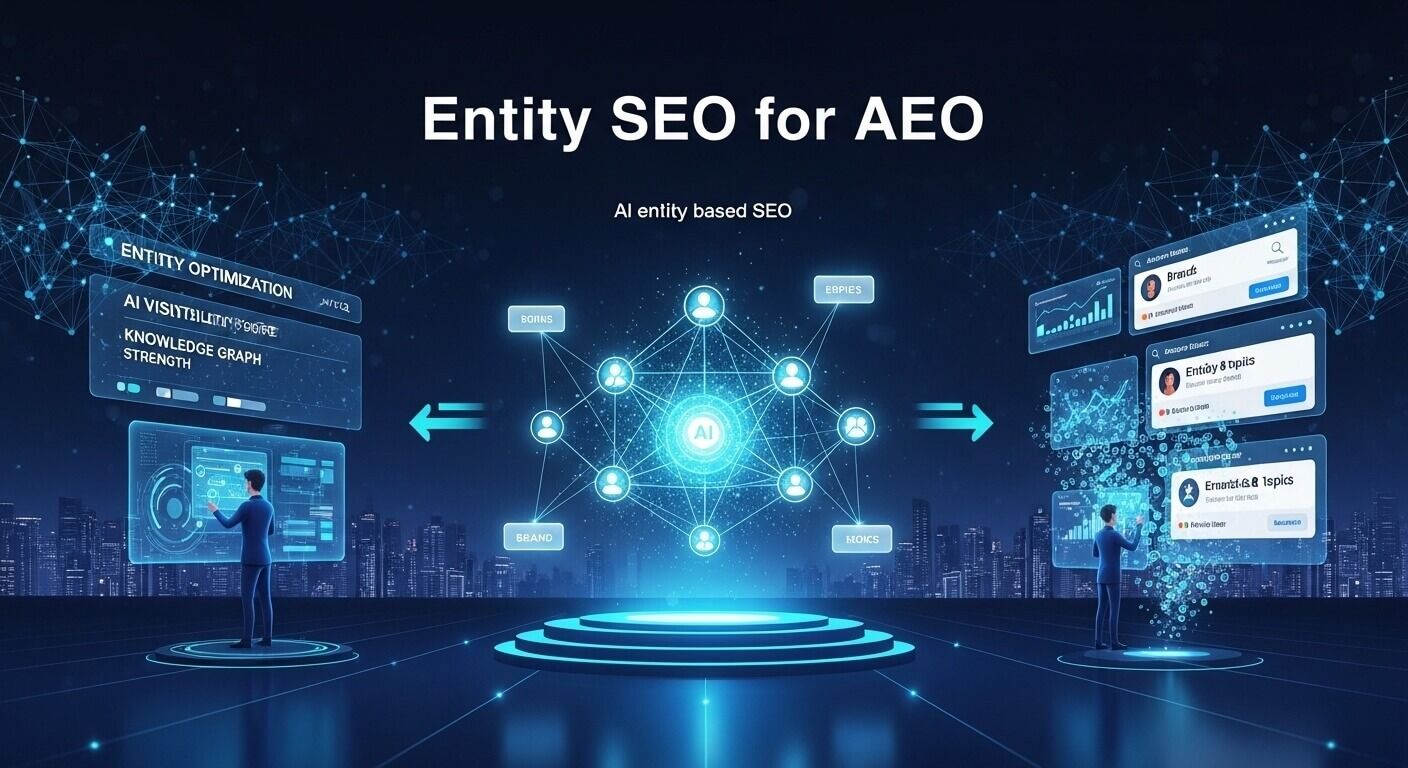
Search engines no longer rely only on keywords. They rely on understanding.
AI platforms like Google SGE, ChatGPT, and Perplexity AI interpret content by identifying concepts, relationships, and context. They do not just read words. They understand meaning.
This is where entity SEO becomes important.
Entity SEO helps search systems connect ideas and interpret content more accurately. It strengthens how your content is understood, which directly impacts how it is selected for AI-generated answers.
To understand how this fits into the broader system, refer to the Answer Engine Optimization Guide.
What Entity SEO Means in an AEO Context
Entity SEO focuses on optimizing content around clearly defined concepts instead of just keywords.
An entity can be:
- A topic
- A brand
- A person
- A process
Search engines map these entities using systems like the Knowledge Graph.
In an AEO context, entity SEO helps AI systems:
- Understand what your content represents
- Connect it with related concepts
- Evaluate its relevance to a query
This improves your chances of being selected as part of an answer.
How AI Systems Use Entities
AI systems rely on entities to interpret content at a deeper level.
Instead of matching keywords, they:
- Identify key concepts
- Map relationships between topics
- Build contextual understanding
For example, content about AEO that connects with related topics like semantic SEO, search intent, and structured data provides stronger signals than content that focuses on a single term.
To understand how context works, refer to Semantic SEO Explained (/semantic-seo).
Why Entity SEO Matters for AI Search
Entity SEO improves how content is evaluated and selected.
It helps AI systems:
- Interpret meaning more accurately
- Identify relevant sections faster
- Connect your content to broader topics
This leads to:
- Better visibility in AI-generated answers
- Stronger contextual relevance
- Improved authority signals
Entity SEO is a key layer in making content “understandable” for AI systems.
Building Content Around Entities
Content should be structured around key entities and their relationships.
This involves:
- Defining the main topic clearly
- Including related concepts
- Expanding context through explanations
For example, a page about entity SEO should naturally include references to:
- Knowledge Graph
- Semantic SEO
- Topical authority
- Internal linking
This creates a connected content experience that AI systems can interpret easily.

Role of Context in Entity SEO
Context strengthens entity relationships.
AI systems evaluate how well different concepts are connected within your content. The more clearly these relationships are defined, the stronger your content becomes.
Context is built through:
- Topic depth
- Related content
- Logical structure
This improves both understanding and selection.
Entity SEO and Topical Authority
Entity SEO and topical authority work together.
Entity SEO defines the concepts. Topical authority expands them.
When content consistently covers related entities, it signals expertise. This increases the likelihood of being selected by AI systems.
To understand this connection, refer to What is Topical Authority in SEO (/topical-authority).
Internal Linking and Entity Relationships
Internal linking helps reinforce entity connections.
It allows search engines to:
- Understand how topics relate
- Build context across pages
- Strengthen authority signals
A well-connected content system performs better than isolated pages.
Internal links should connect related concepts naturally, not forcefully.
Common Mistakes in Entity SEO
Many businesses fail to use entity SEO effectively.
Common issues include:
- Focusing only on keywords
- Ignoring context
- Creating isolated content
- Lack of topic depth
- Weak internal linking
These reduce the effectiveness of entity-based optimization.
To avoid these issues, refer to common SEO mistakes (/common-seo-mistakes).
How to Improve Entity-Based Optimization
Improving entity SEO requires a structured approach.
Focus on:
- Defining key concepts clearly
- Expanding related topics
- Building context through content
- Connecting pages through internal links
- Maintaining consistency across topics
This approach strengthens how your content is interpreted.
Entity SEO in AI-Driven Search
AI-driven search systems rely heavily on entities.
Platforms like ChatGPT, Google SGE, and Perplexity AI use entity relationships to generate answers.
Content that clearly defines and connects entities is more likely to be selected.
This makes entity SEO a critical part of AEO strategy.
To understand how search is evolving, refer to future of SEO (/future-of-seo).
Conclusion
Entity SEO improves how content is understood by search engines and AI systems. It shifts the focus from keywords to meaning and relationships.
In an AEO-driven environment, clarity and context determine visibility.
Content that defines concepts clearly and connects them effectively has a stronger chance of being selected as part of an answer.
FAQ
What is entity SEO
Entity SEO focuses on optimizing content around concepts and relationships instead of just keywords.
How does entity SEO help AEO
It improves how AI systems understand and interpret content, increasing the chances of selection.
What are entities in SEO
Entities are clearly defined concepts such as topics, brands, or processes.
Why is entity SEO important
It helps search engines understand content context, improving relevance and visibility.
"Entity SEO strengthens context and connections, helping AI understand content better and improve visibility in answer-driven search experiences."