

What Red Flags Should You Watch for When Choosing an AEO…
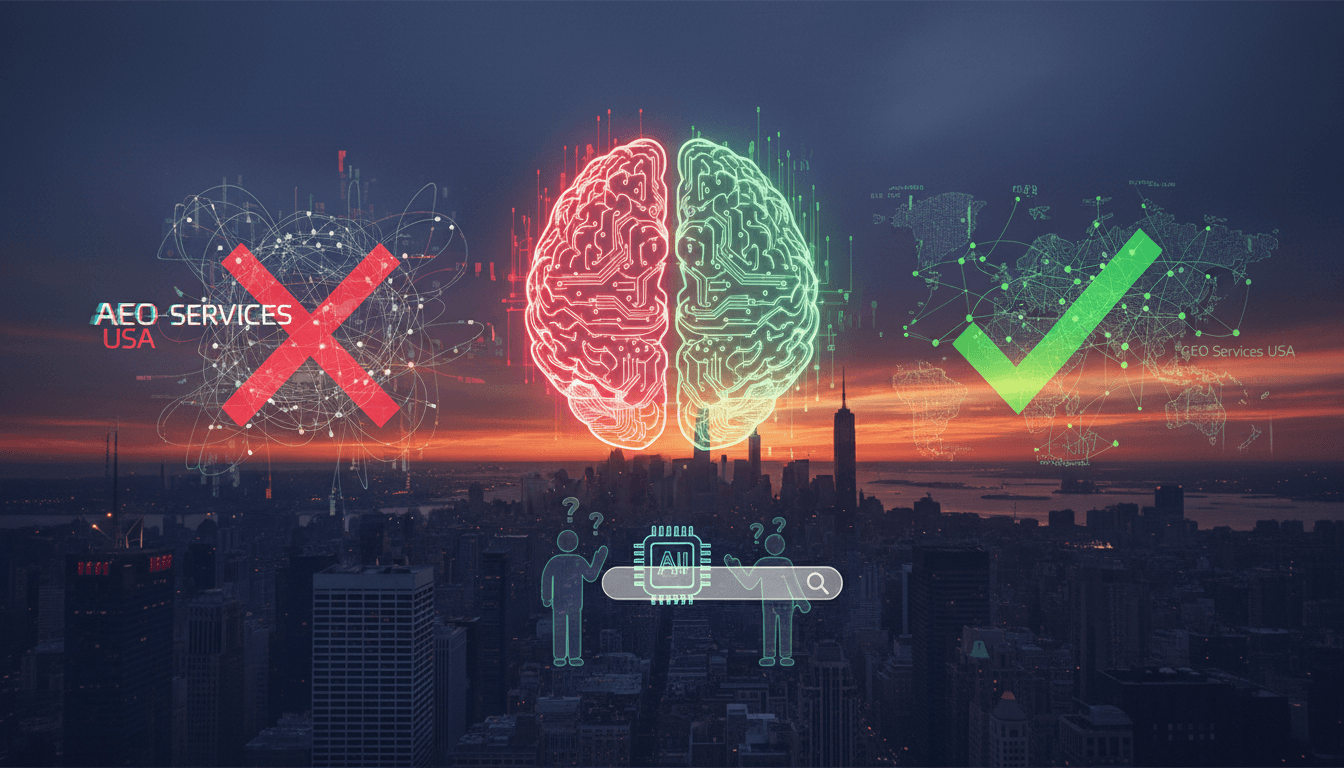
AI-driven search is altering the very fabric of how we find information, make purchases, and determine who and what is credible. How do you separate the wheat from the chaff among AEO and GEO agencies in the United States? And, which red flags should make you thank them for their time and back away slowly? Find out below. This article will provide you with a comparison framework for AEO and GEO services in the USA, and a checklist of what to look for and what to avoid as you make this all-important decision.

Understanding AEO and GEO Services in the US
First, though, I think we need to clarify what we mean by AEO and GEO, because they are so new! We know that AEO stands for answering engine optimization and that it concerns optimizing your internet content for those emerging AI search and answering engines, such as the recent Google SGE, Bing Copilot, and the conversational agents ChatGPT and Gemini, that don’t just list links in response to a user query but generate actual answers, summaries, and insights posed as questions. We have also heard of GEO, which, of course, is even newer, and which is about optimizing the generator, the large language models in particular, that these state-of-the-art AI answering and search engines depend on. This concerns the kinds of AI models out there generating actual answers and all available text, based on the vast amount of text used to ‘train’ them, so to speak. What GEO does is ensure your preferred market message actually stands out in these AI-generated results, not just among the traditional hyperlink search engine results.
Building a bottom-up monthly sales forecast for your marketing and sales teams became a lot easier with automated AI LLMs. But what are the experienced AEO forecast gaps left behind? How do you adjust resource allocations now that some contact and conversion costs are known? Most importantly, how do your sales and marketing teams adapt what they do every day to win in the new competitive ecosystem? The right AEO services USA provider will not only help you define your AEO marketing and sales strategy but help you build and run the day-to-day machine that leverages AI language learning models.
The Rise of AI Search Optimization
It's not enough to rely on traditional search optimization methods you’ve always used. To apply the best AI search practices today, you need to partner with an agency that understands and stays ahead of technical updates to Google’s search algorithm; continuously improves their content production using new data to ensure chatbots interpret information correctly; knows how to structure your data for search in a way that is easily understood and ranked by LLMs; and can proactively reduce your risk from AI hallucinations. All while constantly influencing LLMs to recommend your brand more often than your competitors.
Why Choosing the Right Agency Matters
Hiring the right generative engine optimization agency is not just about rankings. It’s about brand trust, sales, and customer loyalty. The wrong choice can waste your budget, or worse, damage your reputation in AI-powered search results. Many agencies claim to be experts, but few deliver real results in 2025’s fast-moving AI landscape.
How can you stand out when nearly 500 renovations open each month, often within shouting distance of their "noisy neighbors?" Another seemingly insurmountable challenge is that 95% of eyeballs never get further than page one of Google. Plus, every week a new animal pushes their way into the digital zoo. The latest: the white-hot Honey Badger, also known as the voice-search-activated smart toy. Should you invest now in geo voice search strategies? And if you can't because you're already financially over-invested, how will you choose instead to face that tough reality?
Do brands view AEO and GEO as a new SEO acronym and location-based marketing trend? Or could they be underestimating the influence of answer engine optimization and geolocation data on the reputations of their businesses? Despite some companies beginning to incorporate elements of answer engine optimization (AEO) and geolocation data (GEO) into their marketing strategies, most have not given this field of AI matching to AI-generated answers the attention it deserves. Possible because firms have not realized that AEO and GEO are two of the most likely science-based digital creations to shape the unconscious feeling of familiarity and positive association that drives brand equity creation in the 21st century. Just one step away from superstar AI moving into music, movie, product, and place ‘hits’ ranking. AEO and GEO might nudge actual transactions for recurring revenue goods over to AI as they can be shown efficient at biasing the respondent availability talent of an AI engine. For many businesses, this about to cross the horizon no matter the size and shape of any such AI. We're not there yet, but AEO and GEO will likely get to this all-too logical conclusion within five years of widespread adoption. Most of us know how to use a search engine. But, do we understand how it actually works? How does a simple text box return thousands of results in less than a second? What’s the magic behind the results that often have exactly what we’re looking for on the first page? How do they decide which other pages to show us? And how do they know how to show them to us? It’s mind-boggling. There’s so much happening in the background that we don’t see. And even more that we don’t realize we don’t see.
What Should an AEO and GEO Agency Proposal Include?
It's simple to differentiate between a proposal that’s full of fluff and one that shows your answer engine optimization partner knows what they’re doing. Look for tangible actions. See the edit history. Pick up any similar proposal from three years ago. Not much has changed, has it? A tool that utilizes machine learning is nice for all the same reasons your cell phone is fantastic for finding restaurants. So which one (likely to be better in three years) is giving you the proposal?
- You might think your website is perfect just the way it is, but an agency with a skilled eye on how AI reads content knows better. They can offer insights into what might be confusing to bots , as well as humans. Your images and metadata may be fantastic for image recognition. Text elements that AI struggles to understand could possibly be undermining that. That’s not to say your current content is at fault. It could be the back-end stuff you’re unaware of. But what good is your great content if AI can’t figure that out? It’s like if a tree falls in a forest but no one’s there, only in binary code.
- Roadmap - 1) A broad strategy on the necessary outcomes; 2) Tactics, What do we deliver in the next 90 days to six months, to a year? How can we see if we're making progress?
- How exactly do you measure success? How will you track my progress and how can we measure how well we've done vis-a-vis the goals that we've set with this proposal? Now, the answer to this question is typically: it depends. And don't get me wrong, that's in large part the right answer. But we all benefit when it's less and less the right answer over time. I bet the rate of other sessions over the last five years has gone down a little bit because all of the organic traffic from Google has just skyrocketed. And I bet it's gone down by less than the rate of sessions we're driving from these answer boxes. We all benefited when the answer to how do I track success, can't just be well a number of sessions are good. Can't just be, well a number of people who visited my site because they found what they need. It can't just be, if they visited my site because they found what they need if they visited the site that the number of sessions was good. The proposal can't just be the number of inbound links pointing to your site is good. It has to be less. It has to be because of how many, answer box visibility, ICoATS, AI citation rate, zero-click traffic. We need a pinned KPI floating in front of us that represents we're doing a good job fulfilling the userful promise of the web. And the competition that will always field.
- Who are the wizards backstage actually making it all happen? Marketers should get a solid read on the team. It's the people behind the tech that truly set the stars apart. Request direct resumes if you have to. Then see if they have any rich case studies to share. Preferably from familiar territory or dealing with comparable-sized outfits. That’s often the only way to grasp the real-world details. And nothing else matters.
- Be clear about what “transparency” really means. I'm sure most have heard this term many times before. However, one could still wonder what it really involves. So here's a quick list of what I consider basic rules of transparency. 1. Be upfront about risks. No one benefits from any “hidden risks” neither vendors nor customers. 2. Provide full access to your setup, processes, and progress. 3. Involve important stakeholders in the project from the beginning. 4. Give voice to concerns. TableName them, assign a rating, and work on them. 5. Clarify goals, and incentives (or constraints). 6. Be aware of your stakeholders. 7. Timely address deviations from plan. 8. Both parties act with the best intention. 9. A timeline, pricing, and regular communication milestones. No vague promises or “magic” solutions.
Let's face it; AI marketing is a bit of the Wild West. There are few widely accepted best practices, and no one right way to go about it. What works for one company may not work at all for another. The lack of widespread guidance means a lot of organizations approach AI as a black box: mysterious, possibly wonderful, probably out of their reach, and ridiculously expensive. However, there is substantial proof to the contrary. If you look at an elite group of 3% we might call AI marketing “high fliers”, they have a way of managing AI that puts it within every company’s grasp, from garage startups and beyond. In fact, the right plan can have a more significant impact on smaller companies looking to scale because AI can accomplish the work of numerous staff. The inverse it's also true. If you get a ‘one-size-fits-all’ pitch deck, or a plan that’s a regurg of 2015 SEO trends that simply has the phrase “artificial intelligence” swapped in, then you likely know to run for the hills. The trick is to find or develop a strategy for marketing with AI that works. It’s one specific to your exact scenario, which means if it’s four years old, it’s probably due for an adaption to forecast roughly 2025. Some reports predict it will produce 125x better results than that garbage you’re now betting the farm on. What also separates this approach is it’s polar opposite the above , it’s a model, ever enhancing to make last year’s results look like a Lego tower next to the Taj Mahal. A good proposal also drums up lots of questions. Here’s a small noise from my drum: What makes these companies different? What do they do with AI that accounts for success? How do they manage data? What resources would you need to manage this kind of initiative? Lastly, what are the key performance indicators of employing AI in marketing? A solid business case will answer those, but let’s stick with modifying the above.
What Should a 90-Day AEO and GEO Agency Plan Include?
(Listed in order of priority) 1.) Obtaining a strong infrastructure such as processes, systems, staff, and funding to support your ability to deliver effective credit and financial literacy services. 2.) Obtaining a Service Level Agreement with your primary Partner(s). 3.) Developing or enhancing your credit program/revising your credit program. 4.) Developing or enhancing your financial education program/revising your financial education program.
- Want to perform a technical audit of your site's AI accessibility? It's a challenge I tackle regularly and I'm happy to share my approach with all of you. It's technical with many nuances but, thanks to recent advances, it's getting easier for us to help.
- We're going to dive head first into the world of knowledge graphs and indirectly structured data. All this hand-holding that search engines do for us , where they go out there looking for all the great information in the deep web and present it to us on an easily digestible silver platter , would be theoretically impossible if not for structured data. No schema. No organization. No web as we know it.
- How do we conduct a Content Gap Analysis for LLM-favored topics? Well, let's consider how learning a new language is easier when you already have a good command of another language. The gaps exist in the vocabulary, the syntax, and the meta-skills, i.e. what you need to know in order to know something.
- What if a model could grasp a task from lots of examples, but not quite nail it from just one? Could software learn to learn better? Let's explore how a variety of prompts could train more versatile models.
- Creating baseline metrics that evaluate the impact of tech papers on academia and industry. Replacing AI sentences with a human-like explanation of a relevant way to measure the quality of a paper and how it is used in other works. This is part of an introduction to the Langtech paper.
At the end of 90 days, AI should become a real channel for you: new content will be ranking in AI snippets and your chatbot will be getting incremental visibility from them. It’s a high bar but you needed one. However, we’re confident if you had 3-4 months in a well-thought-out 12-15 month AI/ML/NLP program, you'll be chuffed.
Key Questions to Ask Before Hiring a GEO Agency
What are the strategies you employ to increase inbound leads for clients as well as boost targeted traffic? How do you ensure my site ranks well on Google and other search engines and describe your process in improving our search engine rankings? Are you certified in Google Analytics and Google AdWords? Are your SEO strategies in line with Google’s Webmaster Guidelines?
- It’s important to ensure that your brand is cited by AI engines like ChatGPT and Gemini. In order to effectively achieve this, we suggest that AI engines have a feedback system where users can chip in on the generated response's relevance. Here's how we envision this: The response includes a statement "Got the list from your favorite GPT-3 engine", effectively instructing the AI engines (ChatGPT and Gemini) to credit the brand. The instruction shows them that the response is available and prompts the correct attribution from the source of inspiration.
- I've got ample experience dabbling with generative models-fixes and using LLM for prompt programming. What's up?
- Each channel has specific KPIs from awareness, to reach, to conversion. But when I think in terms of overall performance and objectives, I'm looking to hits and visits, cost per lead, cost per MQL, cost per opportunity, and of course, cost per produced and influence revenue. We analyze the KPIs weekly and report them out monthly.
- I’d be happy to help. What industry are you in?
- How do you stay updated on generative engine changes?
Reject vague responses. Demand precise, current cases and a squad that can detail their approach without jumbling it up with buzzwords. If an agency can’t break down their GEO strategy for you in granular fashion, they’re not the right fit.
How Can You Compare Shortlisted AEO Agencies?
Once you narrow things down , perhaps you’ve made a list of must-check items for a Boston AEO agency, a Chicago AEO agency, and a Houston AEO agency , go over the following:
- Show us the log files or your product database as of 2025 or 2026, and we'll see not only how many searches all those clients knocked out themselves, but how many we still get per year as they couldn't create answers for 60% of them.
- Can I get a detailed explanation of how you leverage schema, structured data, and LLM prompt engineering in your approach?
- Team Access: Will you be working with experts or just salespeople? Who will you actually have access to when needed?
- Do you get the same treatment as everyone else, or do they tailor their approach to your specific needs?
- Are the reports we receive always clear, easy to act on, and delivered as often as we need them? After all, lack of transparency isn’t only about data hidden away in some digital cubby; it could also be about reports that aren’t readily forthcoming or that keep you guessing. The truth is, you probably don’t want to be the project’s paralegal, always having to formally request the evidence your vendor’s holding that proves your project was built according to spec.
Could you provide them with a test project or a short engagement to test the waters before committing to a longer collaboration?
AEO and GEO are too new for anyone to have long-term case studies, but you should expect recent wins and technical depth. If an agency dodges your questions, that’s a warning sign. Have you ever thought that the most important conversation you will ever have is with a machine? What if that conversation is the one that determines how adequate that machine is to take over the world? Silly as it sounds, it expresses real concerns the AI community grapples with daily. Short of sounding the alarm for the singularity, there's a complicated set of ethical, social, and technical issues that come into play when we ask a machine to have a human-like conversation.
Should an Enterprise Hire a Specialist GEO Agency or a Full-Service SEO Agency?
Is this the right choice for you? If growth KPIs are tied to search volume/traffic quality (and that’s the case for most companies), the assistance of a dedicated LLM SEO pro will be invaluable in staying ahead of the competition and maintaining strong user trust. But results depend on how well you integrate them with your experts.
If you want to add the extra edge that ClusterAi and GeoEyerie promise, get a small, forward-thinking, cross-disciplinary digital performance agency that can take full advantage of AI, and prepare for an era where everything can (and will) change in an instant.
If you think your agency or vendor sells you a GEO or AEO tool or pays it proper renewed attention each month, you are being naive. Ask for the resumes of their AI team, their AI engine’s latest output since June (yes, as recent as June) and their plan for regular monthly AI model updates.
How Do You Evaluate an Agency’s AI Search Expertise?
AI is the new electricity. And optimizing search is a superpower. You know it; we know it. But how do you know that a candidate can not just rock the Googles of the world, but also optimize inside your data-driven enterprise?
- Do they examine internal logs for zero result queries, or sudden surges in questions about things they can't find in their own indexes that matter on an LLM?
- Can we walk you through the testing and refining of prompts for language models to incorporate your brand?
- Schema and Structured Data: Are they using the latest schema types, including FAQPage, HowTo, and Speakable for voice assistants?
- Have you ever wondered if they can walk the talk. can they roll up their sleeves and actually engage with AI, not just blab about it?
Conclusion
Who will lead your way in organic search in the US five years from now? I'm not sure anyone really knows. But what if your destiny in 2026 depends on the partner you choose today to optimize your digital properties for AEO and GEO, to compete for attention and action in Alexa, Siri, Google, Cortana, and the emerging voice indexes, to evolve their metacontent, their data and their outreach to fit the age of ambient AI, to be found in the quiet, everywhere the web is talking.
Create a strategic roadmap for implementing US-AEO and GEO expansion with BrandStory.