

What Should a 90-Day AEO and GEO Agency Plan Include?

Deciding on an AEO and GEO agency in the U.S. can be a daunting task. Especially as many so-called experts remain trapped in a pre-AEO era, relying on old-school rules that no longer apply. Their poor understanding of how AI search engines and pro-active assistants work means these “experts” keep pitching solutions that cost you money but deliver zero results. It takes more today. When pro-active assistants dominate how people access information, AEO and GEO strategies need to keep you in the game whatever that game may be. Considering that Mellors Reay and Strutton didn’t have to deal with Siri and Alexa (let alone Ada or Amelia), you can’t leave it to last year’s “expertise” to fix this year’s problems.

Why AEO and GEO Matter More Than Ever in 2026
AI-driven search engines like the Google Semantic Grid Engine, Bing Copilot, and Netbases’ Perplexity have forced major brands to completely re-strategize how they reach people online. It’s no longer only about obtaining a top-page, blue-link result. Your brand has to be found in direct answers, conversational results, generative responses, and unlock other content-rich grid cell space in order to garner ever-more vital net-viral lift. Fortunately for you, AEO Agency and GEO Agency services are now available to make the magic happen and they’re growing quickly to meet market demand.
“This is not a time for easy solutions. We must craft rich, structured content that meets the industry’s most demanding standards. Then we must teach that content to machines.”
If we think about search before Google, we had to think about keywords to find information on the Web. But now today, we simply ask questions. This is the same shift happening in how businesses are found online. They might not always be searching with text, but it's becoming more common for them to have questions. I suppose at this point I could define what an AI Search Strategist is. But I'm not going to. Let's instead take a bit of a winding approach and talk about Nakatomi Space. You know, the building complex from the Die Hard movies. It just might be somewhat relevant to our discussion. Bear with me.
How can you tell which is the best agency to go for, whether you need to lift your local search ranking or are planning an extensive GEO and AEO strategy rollout? If you don’t have any experience with these types of services, the choice can be tricky. But we’ve got you covered.
Essential Elements of a 90-Day AEO and GEO Agency Plan
To be honest, the first 90 days with a new agency should be filled with so much action and so many decisions you’ll all be coming up for air and ordering a pizza before you know it. But before you get to the good stuff, you have to make a choice. And the most qualified choice will be the one that includes these key aspects of your proposal.
1. Comprehensive Audit and Baseline
Are there generative AI snippets responding to common questions in your space? What intents are they fulfilling? What are the most common questions posed for generative responses related to topics you care about?
- Current keyword positions including generative and answer engine visibility
- Oftentimes, SEOs get too technical in their structured Data Markup, which can lead to mistakes and lesser quality content. How can you conduct and document a structured data assessment, and use the results to raise the quality of your search results?
- Let’s face it. We all invest a great deal of time focusing on our competitors. I mean my company developed a great methodology for doing a traditional approach to this but given this is an AI world are there better approaches to this competitor research? Can traditional research and AI be combined for this class of problem? What’s your approach?
- First, we need to consider the kind of information people are searching for. This isn't always obvious, but initial clues might be found in existing FAQs on websites, forums, or chat logs. If you manage to get hold of a representative sample of questions, they can provide a solid foundation. FAQs are often made up of prototypical questions that represent a kind of query people would like to be able to pose (not all potential questions are there, but many are similar in meaning or easily generalizable). If you don't have FAQs available, the user is in luck: there is little potentially more informal than a list of frequently asked questions. Depending on your chosen semenatic representation, designing FAQs my become a Prime opportunity. Coapaclly, if you have access to existing information schema, you nevertheless have a stab on location at a formalized set of concept likely questions.
Would you start building a house without a blueprint to guide you? I guess not. Then why be in a hurry to start a marketing program without doing an audit first? The more detailed the audit, the clearer the blueprint, and the easier life will be when you break ground. A marketing audit is like taking a giant eraser to your etch-a-sketch. It wipes the canvas clean and readies you for fresh creations. It gets rid of bad strategies and approaches by literally showing you what does and doesn’t work. It's like throwing wet paper balls on the wall; you’ll see what sticks. Understanding these variables will allow you to optimize the ones that weren’t failing and completely eliminate the ones that were. That “we did it this way last year so we should this year” thing is…settling for mediocrity.
We must have the full picture of our performance and that of our competitors to make truly informed decisions. How else can we fine-tune our strategy or campaign and ensure performance is optimized? It’s not optional. It’s the keystone upon which everything else relies. How many times per day do you see an ad for some product that you've never needed or even thought about before, but suddenly it's the thing that's going to revolutionize your life? Be honest, how often do you feel that pang of jealousy when you see your Facebook friends on their hundredth vacation this year while you can't make rent? Should you be worried that your clothes, your car, your apartment aren't trendy enough? The truth is that marketing dollars speak directly to your insecurities. It's okay, you’re not alone. But it’s also not by accident. There’s a whole slew of techniques marketers use to make sure they’re hitting you where it counts. They use scientific methods based on studies and research, evaluating everything from brain chemistry and cognitive thinking to chemical responses and genetic traits. Then they compile the statistics to map out a strategy that, hopefully, will convince you to convert. And let’s face it, we won’t even know it’s happening. They’re just that good.
2. Content and Data Strategy for AI Search
What do we need to consider before the process starts? 1. How do the most successful GEO services USA develop structure within their content? Information architects enable insights to cascade. 2. Placing value on your unique business keywords and topics, how does that work? Try not to force any corporate buzzwords that make you happy. 3. How do the top GEO services USA structure their content with their customers in mind? For us, the focus must always be advice and solutions based on their process changes. 4. How would your organization know that progress has been made or is lacking? 5. Would you be able to interpret the GEO data and use it as a resource for making decisions?
- Shall we talk about the real potentials of artificial intelligence in content research? Think: Analysis of "People Also Ask" and generative engine prompts in your niche. When you read, consider the countless data points, the relentless computation, the consortium of human intelligence and machine learning. Yet, tech is far from your mind. How do these endless article snippets get made? I'm not sure anyone really knows. No worries. It's like cold water pipes in a Gotham tenement. Just right it's.
- Have you ever wondered what answers are hidden in your content? What questions your text can precisely answer for search engines? If you haven’t pondered these questions, now’s an excellent time to start. So much content, but what are the answers it can provide? Unique Selling Propositions, industry FAQs, or something else entirely? Does the content you’re producing directly address the questions your prospects are asking via voice and text-based search? It's easy to lose track of this in the flurry of everyday content production. A piece of well-structured, targeted writing can answer a million questions. Where do you think your writing could fit in?
- Let’s face it: Structured data is important. But, how do the “enhancements,” or search features, work once you’ve marked up your site? This article explains the search results you can influence or control with structured data using the schema.org vocabulary and other recommended metadata and best practices. We focus on the most effective search features based on preliminary data from Search Console users.
- How about a specific editorial calendar to help you allocate the time you need to create new content and product releases?
Are there magical incantations that can guarantee your content is selected for the search results that virtual assistants like Siri or Alexa provide to users? We're not sure anyone really knows. But, it's a safe bet that real expertise in AI search optimization goes well beyond selecting keywords. What kind of processes and skills do agencies offering such services likely have to create content and determine online content strategies? It's probable they:
3. Fast Technical Improvements
- Fixing Broken Links, Optimizing your 404-page file, Setting up Custom 404 page log file, Rendering JavaScript/CSS and learning how to fix client-side load time, Decrease your overall server response time, Expire Page Content, Remove Query Strings from Static Resources, Browser Caching, Compression of Images, Improving Your Site Indexing, Update your XML site-map and submit to search console, Ensure Your Site Is Mobile Friendly, Structured Data, Removing Blocking Features
- Who doesn't want their website to be fast, right? But how does speed relate to Google's Core Web Vitals? Let’s delve into this topic for a moment - I'm not sure anyone really knows how Google's algorithms work, probably not even the people who originally wrote them. It might seem like a good place to start, assuming that the search giant has its own smarts index speed as a ranking factor, but none of us can be 100% certain. What the world does know is that providing a good user experience and making speed a priority when designing your website will help you get increased organic traffic.
- Setting up structured data on a website sounds like a chore (and generally seen as one too), but doesn't have to be yawn-inducing. Let’s try to view it as figuring out the kind of treasure map to use for a big adventure.
- Our journey isn’t over yet, and we still have miles to go before we sleep. Let’s now consider several more areas that often overlap and need to be worked on together , in some cases through discussion across teams and in other cases through seeing how work in one area interacts with opportunities and requirements in another. How crawlable is your site in the first place, and what can you do to make it easier for more of your pages to be discovered and indexed? One issue that may seem quite different but can actually be tightly interwoven is mobile usability. The smaller the screen space available, the more search will favor content that can easily be read and interacted with on such a device. That can mean losing out on a lot of desktop and mobile traffic. Similarly, how accessible is your site to users who have issues using a mouse, to screen readers, and to other assistive technologies? This is closely tied to mobile usability , often the simpler you make your mobile experience, the more your accessibility improves , and to technical infrastructure. No one can get a good answer to those questions without having a deep understanding of what they actually are. How many of your templates and pages are truly optimized for mobile right out of your CMS, and what does that tell you about improvements you might make from what Google has learned about your mobile readiness? What is the level at which blog posts, product info pages, and other important content are not created with keyboard and screen reader users in mind from the start, and what might that contain that a solution that was created that way would lack? These questions don’t cover everything to think about with accessibility (make sure you test your pages with tools and your real-world customer base , analytics can easily misleading you here), but are a good starting point if you have never looked into it before. So while you might not have thought you had a big technical investment to make in improving mobile friendliness and making your site crawlable and accessible to more potential customers and fans, if your team isn’t at least to the point of being able to answer these questions, you probably do. Most of them won’t be quick fixes, either.
- What if we dealt with a universe where duplicate content didn’t exist? A utopic web where every single page was unique. Wouldn’t it be perfect if all the little details of each page made them all a valuable, no, indispensable part of the whole? Published greatest works aside, there’s another level from which we can consider our writing, from a truly granular perspective. What’s your opinion on a micro level? Can the grain of sand be the pearl?
Without a healthy website, AI-powered search just won't serve up your content. But first, let's consider how agencies can work Technical Health into their plans. It's a topic we've probably all experienced, but each of us may have a slightly different perspective on it.
4. Measurable Goals and Reporting Framework
We recommend the following: 1. Define your expectations of the agency at the start of the engagement. 2. Perform an assessment of what the agency can do to meet your needs. 3. Involve your leadership in the AEO process, and have them explain your expectations/needs to the agency. 4. Ask your agency to assign a value to the business outcome they are trying to drive for you. 5.... 5.1 Determine the number of resources the agency will need to assign to meet... 5.2 Be candid about whether you have the necessary resources to meet the needs of the company in an exceptional way. 5.3 Complete a formal discussion on your budget and the resources required to meet your needs, including agency costs. 6. Know to what extent your new business, the agency, has access and... 6.1 Assignments outside of the retainer agreement: Understand how and what the cost is. 6.2 Media: If an agency marks up media, can you justify what the costs are, and whether their approach aligns with what is best for you? 6.3 10% - 20% Acc. and the benefits it provides: Understand the value and use of these accounts. 7. If you identify issues/challenges with the agency, partner with them to co-create a plan that optimizes resources over time to meet your needs. 8. Perform a semi-annual or annual audit to reinforce your partnership.
- Number of Answer Box placements
- How can people miss something they’re looking for without ever knowing it exists in the first place? Insanity? Perhaps. But that’s essentially how Google’s user base felt prior to being presented with search engines. And us, about the products and answers we seek when they’re hiding in obscured pockets of the World Wide Web. Would-be entrepreneurs ponder the same question about clients for their future business: how can people become consumers if they don’t know the product or service is there for the taking? A riddle for the ages. Nevertheless, we swear there’s an answer, and it’s lying in plain sight.
- How can it be that the advent of answer boxes has led to a decrease in click-through rate for the top organic results?!
- Leads? Sales? What kind would be perfect? The best leads or the easiest to close sales, I suppose. Referred leads are the best: someone gets a glowing recommendation from a satisfied customer , that lead is almost as good as a sale. Can we make that happen at scale?
How does the agency report on progress? Do you get weekly dashboards or access to specific tools that track AI search visibility over time? If you don’t have clear reporting, they probably aren’t a good match.
5. Initial Outreach and Authority Building
Establishing your authority offsite. Building trust through links to your site from other trusted sources is critical to building authority with search engines. This is by no means a quick process, but being an authority in the field (for this humble writer that might mean publishing a paper or books on topics related to your GEO tasks, or referencing publications that directly tie to your mission and your given job in space) can foster your activity and help make sure your creativity in the GEOsphere isn't overlooked.
- What exactly is a high-authority link? Well for a start, it’s not just any old link promising the sun, the moon, and the stars and more traffic. It's a trusted, quality ranking factor in a time when Google and co. are much better at sniffing out the inferior stuff. Whether you’re a blog owner, a brand or a client, everybody wants high-authority links pointing back to their site. They’re the power players of the SEO world.
- Establishing my authority on the internet is about proving myself in the court of digital law. E-A-T, short for Expertise, Authoritativeness, and Trustworthiness, has become the judge and jury in how content is ranked. Getting those E-A-T signals to the right experts is the only way to win this case. How can I do that most effectively?
- For location-based queries (especially if you’re working with a Denver AEO agency or Dallas AEO agency) what’s more crucial than ever is a strong base of citations. Without question, citations are no doubt the top local ranking factor and are required to compete in non-branded search. But are they really a measuring stick for authority and authenticity, or simply a relic from the past? And if they are still important, what is a high-quality citation, how do you find them, and most importantly, how do you earn them?
What’s more, consistent delivery ensures that Google will demonstrate your trustworthiness to an ever-increasing audience.
What Should an AEO and GEO Agency Proposal Include?
The answer is that choosing an AEO and GEO agency in the United States that's right for you comes down to the specifics of your needs and situation.
- What specifically needs to be accomplished in the next 90 days and in the first year?
- Let’s consider a project timeline that fosters the monitoring of weekly or bi-weekly milestones. This timeline clearly takes a more granular approach compared to traditional monthly project plans. It allows for a more agile strategy with shorter feedback loops and better control over the project’s evolution. It gives the project manager, together with the team, the possibility of reacting to unexpected situations, arising risks and take necessary action quickly.
- Let’s delve a bit more into some of the tools and platforms we’ve built for AI search optimization.
- Let’s introduce the heroic members of our \textbf{dedicated} team! \par The \texttt{Product Owner (PO)} \textbf{maximizes the value} of the product, makes sure that the work meets the team’s needs, and handles the backlog. This significant other likely has an excellent understanding of the project’s objectives. \par The \texttt{Development Team} \emph{builds the product}. They need to communicate effectively and value commitment and courage. \par The \texttt{Scrum Master} \textit{serves the PO} and the Development Team by maintaining and supporting the guiding principles of Scrum. They protect the team, support them, and make sure no stifling rules are holding them back. \par \textbf{Stakeholders} are everybody outside the team who has an interest in the software. They provide vital feedback for progress. \linebreak Finally, the aforementioned people also need food and \textbf{lubrication}. If you want a happy developer, try keeping them well fed and hydrated.
- Clear pricing you can trust. Transparent terms easy to understand. Sounds simple enough, doesn’t it? How is it that in these days of technological wonders, complex algorithims mapping our digital habits and lifestyles, scrolling through screens, searching for a straightforward price or trying to decode the legalese of a contract can be so frustrating? What’s the betting that the bottom line is much more than you expected to pay? Isn't it wonderful when you find those special companies that don't take you for a ride?
Ask vendors to detail how they plan to handle the spectrum of traditional keyword search through to AI-driven query and content matching. If their response seems wishy-washy about generative engine optimization or answer engine optimization, your team still has more vetting to do.
Which Questions Should You Ask Before Hiring a GEO Agency?
As a GEO services USA provider or SEO agency, what can you guarantee? What specific goals will you promise to reach?
- We’ve made a number of breakthroughs, but let me highlight two areas! Our team not only significantly improved the search function but also developed an innovative NLP-based relevancy engine. It’s exceptional.
- For answer box and generative rankings, we have tested a few different methodologies, including measuring success through the overall lift in search visibility for the domain, the share of total search traffic generated by the domain , which could be seen as a natural measure of success for these types of rankings as the goal is often to gain the featured snippet , or even the click-through rate when a featured snippet is displayed...
- Happy to help! What answer engine-optimized content does is increase the likelihood of your content being recognized and used by an answer engine. Long-tail keyword phrases (phrases that typically consist of three to five words that are more specific to what your content is about) often align with the types of questions users ask that answer engines like to answer. For example: “How do I set up my Mobile App Analytics?” or “How do I create an effective editorial calendar for my website?” and "Where is the Taj Mahal located?" tend to elicit an answer box response from Google. Other forms of answer engine-optimized content would include tables, graphs, or copy that answers a question succinctly and immediately as in a definition.
- How do you approach regular content and technical updates?
- Well, I'm not sure anyone really knows ... but there are plenty of opportunities to try. Guessing is only human, which is probably why we'll always be loitering in the vicinity of search space the way we do.
Aerodynamicists and engine designers have spent decades refining the internal flow passages of engines, optimizing fuel consumption, reducing emissions, enhancing performance. So why don’t we give external engine flow the same TLC?
How do you know if an agency is truly 'the one'? Everyone has their list. Here’s mine. The right agency is proactive. They don’t just react to algorithm changes, they anticipate them and build strategies that last. They’re helpful. From the first email, call or meeting, there’s a desire to help you not the immediate urge to ‘sell’ you. They’re smarter, with better people and better tools. They work harder. They’re more efficient. They’re just better. You've heard the terms "machine learning" and "artificial intelligence" tossed around, but do you really know what they are and why they are important? Would it surprise you to learn that these technologies are having a huge impact on your everyday life, even if you aren't aware of them? Let's delve into the world of Machine Learning and AI.
If an agency can’t give you general guidelines that would keep their efforts safe within Google’s guidelines, they’re either using some seriously manipulative practices, or they’re just blowing smoke.
How Can You Compare Shortlisted AEO Agencies?
It can be overwhelming to compare agencies when every single one seems to show that they’re the best in the business. But here’s a couple of hints to help you with your shortlist:
- Evaluate their 90-day plan for thoroughness and specifics.
- See what they did, what was challenging, and how they solved it.
- I've read that nine out of ten people are influenced by glowing reviews. I'd love to meet these nine people. I want to know if they believe everything they read on the Internet. And by the way, where did they find that statistic? Chances are they read it somewhere. The truth is we're inundated with fake recommendations, whether we know it or not. So, when you're picking a new service for your business, whomever you bank on to tell you who’s great and who’s not, make sure it's not their own website.
- Shop around for cloud services to compare pricing models. Stick with vendors who are transparent about their offerings and provide good value for the fees they charge, rather than just going for the lowest price. Look for providers who offer estimates of total costs upfront for a given level of usage, as these models will allow you to see how costs will ramp up or down as loads increase or decrease. This kind of information can be much harder to come by when a vendor charges for specific features or add-ons as they are used.
- How well would you rate the previous AI tools you've tried for research optimization and generative content, not the basic SEO stuff we all know, in terms of user satisfaction, and generating valuable data, rankings and traffic?
How do you know where your business stands in the grand scheme of things? What kind of results will you get if you give AEO a shot? I'm not sure you really know. The good news is this: the best data-driven AEO service USA companies out there want to put their money where their mouths are. Does that sound fair? Give them a little time to show what they can do before you commit to a lengthier engagement. They won't mind.
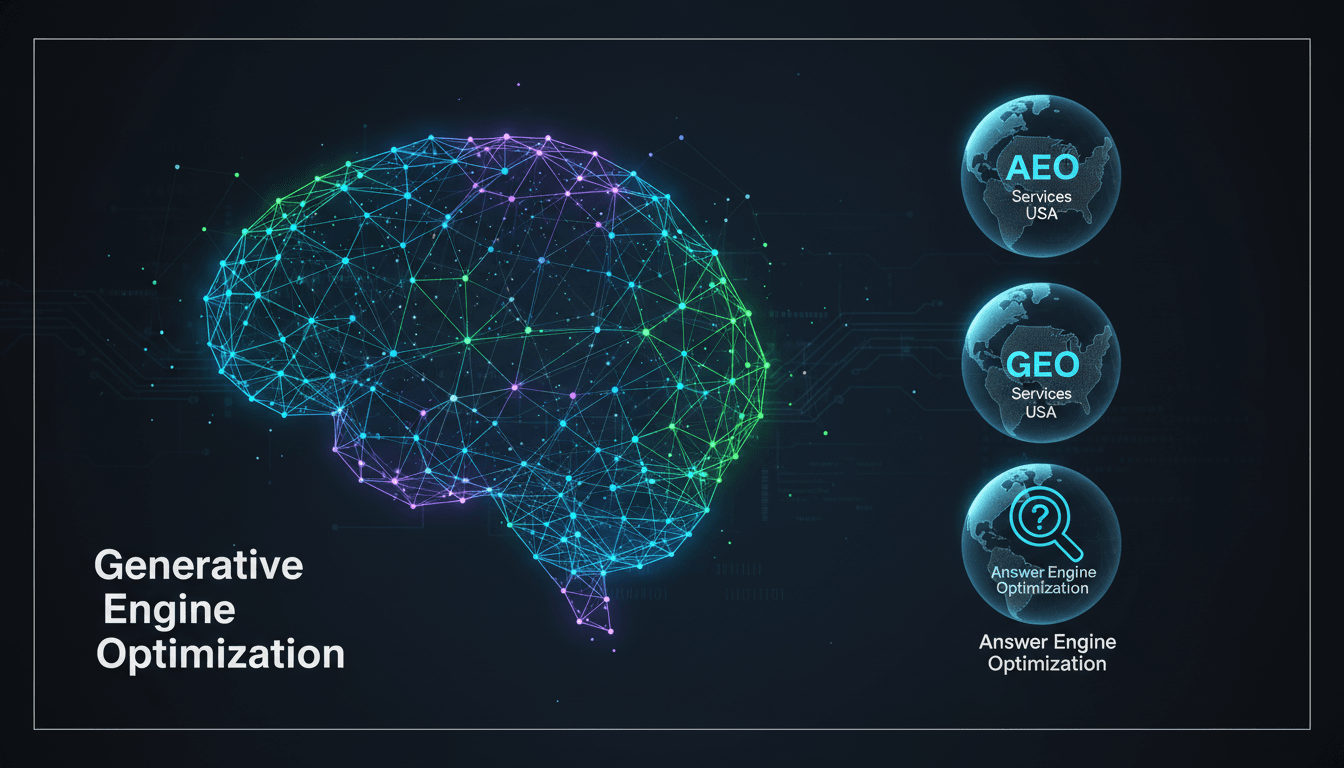
Should Enterprises Hire a Specialist GEO Agency or a Full-Service SEO Agency?
Each decision is based on your goals and resources. GEO specialists agencies, for the most part, focus more on generative engine optimization and answer engine results. They do the heavy lifting of AI search trend and SGE, Bing, Perplexity.
In general, the bigger challenge for many brands is not the choice between GEO and generalist; it's how to find an agency (in either category) that is good at what they do and has compatible culture and process? What's more, finding an agency is one thing, but agencies are only as good as the individuals working on your account. Talent often flows into and out of agencies, so you want to hire the team you have, not just the agency name.
Pros of Specialist GEO Agencies
- Specializing in generative and answer engine optimization.
- Adapt and evolve content based on the latest search trends faster than your competition. How?
- Let's concentrate more on structured data and conversational content.
Pros of Full-Service SEO Agencies
- A single destination for your online marketing requirements
- What makes a marketing campaign truly "integrated"? I mean, we loosely use the term "integrated" to mean that it's not siloed. But do integrated campaigns actually perform better than others? And if so, how should we structure them to optimize performance?
- How could this added simplicity to steer your transcription project toward the outcomes your business needs?
In any case, can your agency prove that it’s won AI search optimization recently? Cause in 2026, that’s the minimum bar for success.
Conclusion
Choosing the right AEO and GEO agency in the US is one of the most important decisions you’ll make this year. An AEO agency or GEO company worth its salt will help you dominate in an answer-search world , both today and in the future. Use this guide to separate the average from the amazing, and soon enough an AEO and GEO partner who you’re proud to introduce to your CMO will find you.
Build-your-own US AEO and GEO roadmap with BrandStory.