

How Search Engines Rank Websites

Search engines do not rank websites randomly. Every result you see on Google is the outcome of complex systems designed to deliver the most relevant and useful information.
Many businesses assume rankings are based only on keywords. In reality, search engines evaluate hundreds of signals including relevance, authority, user behavior, and technical performance.
Modern search engines like Google use Natural Language Processing (NLP), Machine Learning, and Knowledge Graphs to understand content. This means rankings are based on meaning and context, not just keyword usage.
If you are new to SEO fundamentals, start with What is SEO and how it works , which explains how search systems function at a foundational level.
How Search Engines Work Before Ranking
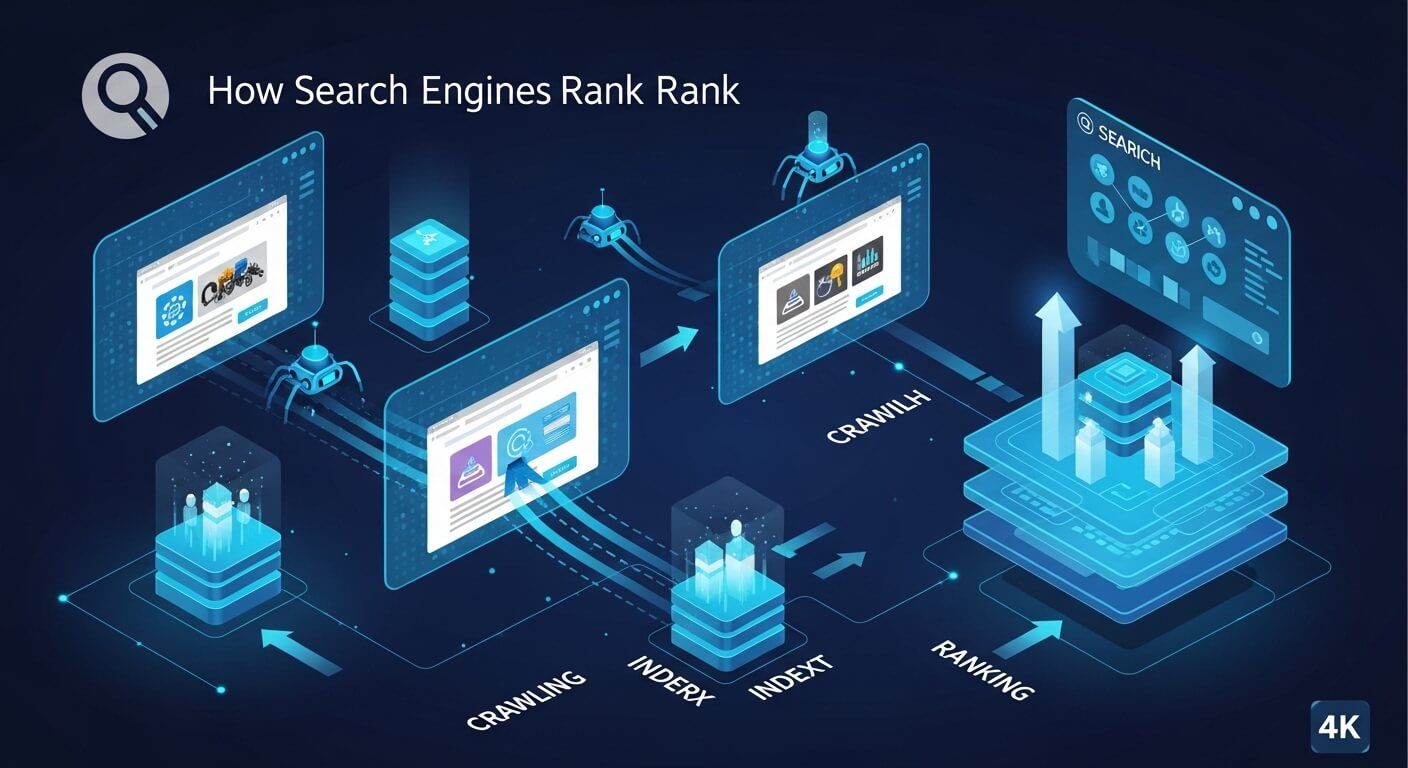
Before ranking any page, search engines go through a structured process. This process ensures that only relevant and high-quality content appears in results.
- Crawling
Search engines use bots (also called spiders) to discover content across the web. These bots follow links to find new and updated pages.
- Indexing
Once content is discovered, it is stored in a massive database called the index. Pages are categorized based on topics, keywords, and structure.
- Understanding Content
Search engines analyze the meaning of content using NLP and entity recognition. They identify relationships between topics and match them to user queries.
- Ranking
Finally, algorithms evaluate all indexed pages and rank them based on relevance, authority, and usefulness.
To understand how these processes connect within a broader SEO strategy, refer to the Ultimate SEO Guide.
What Are Search Engine Ranking Algorithms
Search engine ranking algorithms are systems that decide the order of results shown for a query. Google uses multiple algorithms that work together to evaluate content.
These algorithms consider:
- Content relevance to the query
- Authority of the website
- Quality of information
- User experience signals
- Technical performance
Google continuously updates its algorithms to improve search results. Updates like Helpful Content and core algorithm updates focus on rewarding useful, user-first content.
Search engines also use entity-based systems like the Knowledge Graph to understand how topics are connected.
Key Ranking Factors Search Engines Use
Search engines rely on multiple factors to determine rankings. These factors work together, not independently.
- Content Relevance
Content must match user intent and provide clear answers.
- Authority and Backlinks
Websites with strong backlink profiles are considered more trustworthy.
- User Experience
Metrics like page speed, mobile usability, and engagement influence rankings.
- Technical SEO
Proper indexing, site structure, and performance affect visibility.
- Content Depth and Coverage
Search engines prefer content that covers topics comprehensively.
These factors are constantly refined using Machine Learning to improve search accuracy.To measure how these factors impact performance, explore SEO KPIs to track.
How Search Intent Influences Rankings
Search intent is one of the most important ranking factors because it defines what the user is actually looking for when they enter a query. Search engines prioritize content that aligns closely with this intent.
- Informational intent – Users want to learn something or find answers
- Navigational intent – Users are looking for a specific website or brand
- Transactional intent – Users are ready to take action, such as making a purchase
- Commercial intent – Users are comparing options before making a decision
Search engines analyze user behavior, query patterns, and engagement signals to determine intent. Based on this understanding, they rank content that best satisfies the user’s expectation.
For example, a detailed guide is more likely to rank for informational queries, while a product or service page performs better for transactional searches. When content does not match the intent behind a query, rankings and engagement tend to drop.
Importance of Content Structure and Internal Linking
Search engines rely on structure to understand your website.
Clear headings, logical flow, and internal links help search engines interpret relationships between pages.
Internal linking:
- Connects related topics
- Distributes authority across pages
- Improves crawlability
Structured content also improves visibility in AI search results, where systems extract answers directly from pages.
Common Ranking Challenges
Even with good content, many websites struggle to rank due to common issues.
Key challenges include:
- Weak content depth
- Poor technical SEO
- Lack of authority signals
- Slow website performance
- Inconsistent internal linking
Search engines evaluate websites as a system. Weakness in one area can affect overall performance.
To identify these issues, review common SEO mistakes , which explains where businesses go wrong.
How to Improve Your Rankings
Improving rankings requires a structured approach.
Focus on:
- Creating content aligned with search intent
- Improving technical performance
- Building backlinks from relevant sources
- Strengthening internal linking
- Updating content regularly
SEO is a continuous process. Consistency drives results.
Conclusion
Search engines rank websites based on relevance, authority, and user experience. Modern systems use AI to understand intent and deliver better results.
Understanding how rankings work helps you build strategies that align with search behavior. Businesses that focus on structured, high-quality content and strong technical foundations gain long-term visibility.
"Rankings are not assigned. They are earned through relevance, structure, and trust"