

Ultimate Guide to SEO for Modern Growth
Search has changed. Ranking is no longer about adding keywords to a page. It is about building clarity, authority, and relevance across an entire topic.
Many businesses still treat SEO as a checklist. The result is inconsistent rankings, weak traffic, and low conversions. Modern search engines like Google and AI platforms such as ChatGPT and Perplexity AI now prioritize structured knowledge, not isolated content.
This SEO guide breaks down how search actually works today. It connects strategy with execution and shows how to build long-term visibility. If you want to understand the fundamentals first, start with What is SEO and how it works (/what-is-seo-how-it-works), which explains the core mechanics behind search.
What is SEO
Search Engine Optimization (SEO) is the process of improving your website’s visibility on search engines like Google by aligning content with user intent.
SEO today goes beyond keywords. It includes semantic understanding, entity relationships, and structured data. Search engines use Natural Language Processing and Machine Learning to interpret meaning and context.
To understand how SEO has evolved into this system, explore the history of SEO evolution For a clear breakdown of terms used in SEO, refer to the SEO glossary A to Z .
Why SEO Matters in Modern Search
Search is now driven by intent and context. Google’s algorithms and systems like Google SGE analyze how well content answers a query, not just how many times a keyword appears.
AI platforms such as ChatGPT and Perplexity AI pull answers from authoritative sources. If your content lacks depth, structure, or clarity, it does not get surfaced.
Modern SEO matters because it:
- Builds consistent organic traffic
- Improves brand visibility across platforms
- Strengthens trust through authority
- Enables visibility in AI search systems
To understand how rankings are determined, refer to how search engines rank websites .
How SEO Works
SEO works by aligning content, technical structure, and authority signals with how search engines evaluate websites.
Here is how the system works:
- Search engines crawl your website
- Pages are indexed based on relevance
- Algorithms evaluate content quality and intent
- Rankings are assigned based on signals
To see how this process is implemented in practice, follow the SEO process step by step , which explains execution clearly.
Types of SEO
SEO is not a single activity. It includes multiple areas working together.
The main types include:
- Technical SEO
- On-page SEO
- Off-page SEO
- Local SEO
Each type plays a role in improving visibility and performance. For a detailed breakdown, explore types of SEO explained, which covers how each type contributes to growth.
Key Components of SEO
- Technical SEO
Technical SEO ensures your website is accessible, fast, and properly indexed. It includes site structure, mobile optimization, and performance.
- On-Page SEO
On-page SEO focuses on optimizing content for search intent. It includes keyword alignment, content structure, and internal linking.
- Off-Page SEO
Off-page SEO builds authority through backlinks, mentions, and digital PR.
- Content and Authority
Content builds long-term visibility. Strong content connects topics and builds trust.
To measure how well your strategy performs, refer to SEO KPIs to track , which defines the right metrics for growth.
Best SEO Practices
Modern SEO works best with a structured, intent-driven approach rather than focusing only on keywords.
Building connected content and optimizing technical elements improves visibility and performance.
Consistent updates and strategic execution lead to sustainable, long-term growth.
• Focus on search intent before targeting keywords
• Build topic clusters instead of isolated pages
• Optimize internal linking across all pages
• Use structured data to improve search clarity
• Align content with semantic search principles
• Regularly update content to maintain relevance
Common SEO Mistakes to Avoid
Many businesses struggle with SEO due to incorrect strategies.
Common mistakes include:
- Targeting keywords without understanding intent
- Publishing low-quality or duplicate content
- Ignoring technical SEO issues
- Weak internal linking structure
- Expecting instant results
To avoid these issues, review common SEO mistakes , which explains these challenges in detail.
SEO vs SEM vs PPC
SEO is often confused with other marketing channels.
SEO focuses on organic visibility, while SEM and PPC focus on paid traffic. Each channel plays a different role in growth.
For a clear comparison, explore SEO vs SEM vs PPC , which explains how these strategies differ and when to use them.
White Hat vs Black Hat SEO
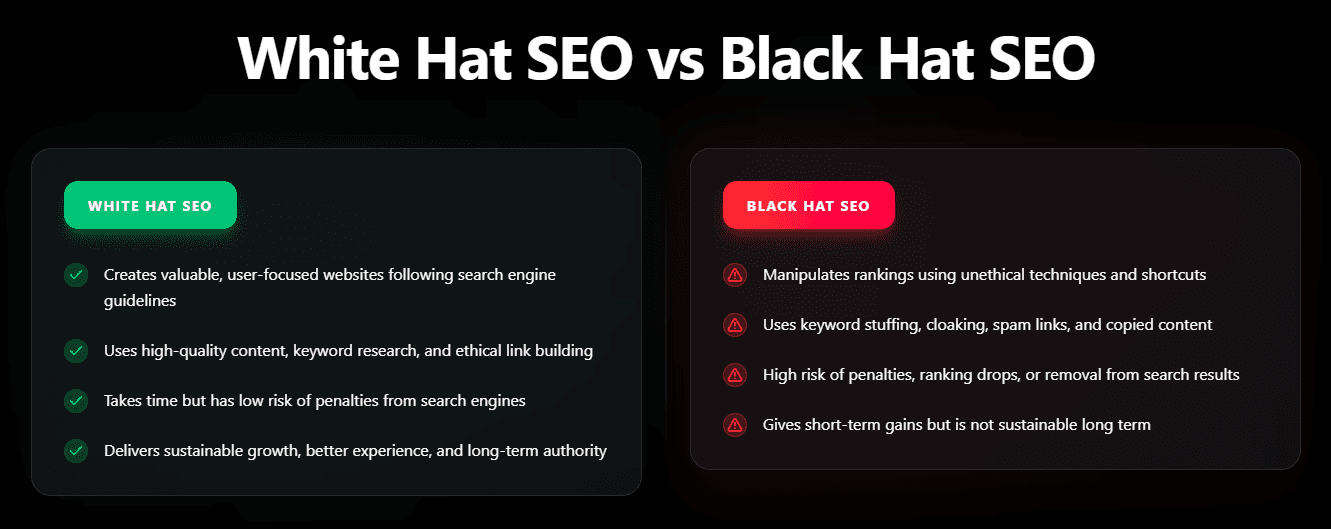
Not all SEO practices are equal. Ethical strategies build long-term results, while shortcuts can lead to penalties.
White hat SEO focuses on sustainable growth, while black hat SEO uses manipulative techniques.
To understand the difference clearly, refer to white hat vs black hat SEO
How Long Does SEO Take
SEO is a long-term investment. Results depend on competition, strategy, and consistency.
Most businesses start seeing measurable results within a few months, but sustained growth takes time.
For realistic timelines, explore how long does SEO take (/how-long-does-seo-take), which breaks down expectations.
SEO Ranking Factors in 2026
Search engines use multiple signals to rank content.
Key factors include:
- Content relevance
- Authority and backlinks
- User experience
- Technical performance
- Engagement signals
Future of SEO
SEO is moving toward AI-driven search experiences.
Search engines are becoming answer engines. Users expect direct answers instead of multiple links.
Key trends include:
- AI-generated search results
- Voice and conversational search
- Entity-based indexing
- Personalized search experiences
To understand where search is heading, explore future of SEO .
Conclusion
SEO is no longer a one-time activity. It is a system that connects content, technology, and strategy.
Businesses that invest in structured SEO frameworks build long-term visibility and consistent growth.
If you want to go deeper into execution, start with the SEO process step by step (/seo-process-step-by-step) and build from there.
For businesses ready to scale faster, structured SEO services help turn strategy into measurable outcomes.
FAQ Section
What is SEO and why is it important
SEO improves website visibility by aligning content with search engine algorithms. It helps businesses attract organic traffic and build long-term brand authority.
How does SEO work in 2026
SEO in 2026 focuses on semantic search, entity relationships, and structured content. Search engines prioritize relevance and user intent over keyword repetition.
How long does SEO take to show results
SEO typically takes 3 to 6 months to show results. The timeline depends on competition, content quality, and consistency of optimization.
What are the main types of SEO
The main types include technical SEO, on-page SEO, off-page SEO, and local SEO. Each plays a role in improving website performance and visibility.
What are SEO ranking factors
SEO ranking factors include content quality, backlinks, user experience, and technical performance. These signals determine how pages rank in search results.
"SEO works best when it’s treated as a system, not a set of tasks."