

AI Search vs Traditional Search: Key Differences for Businesses
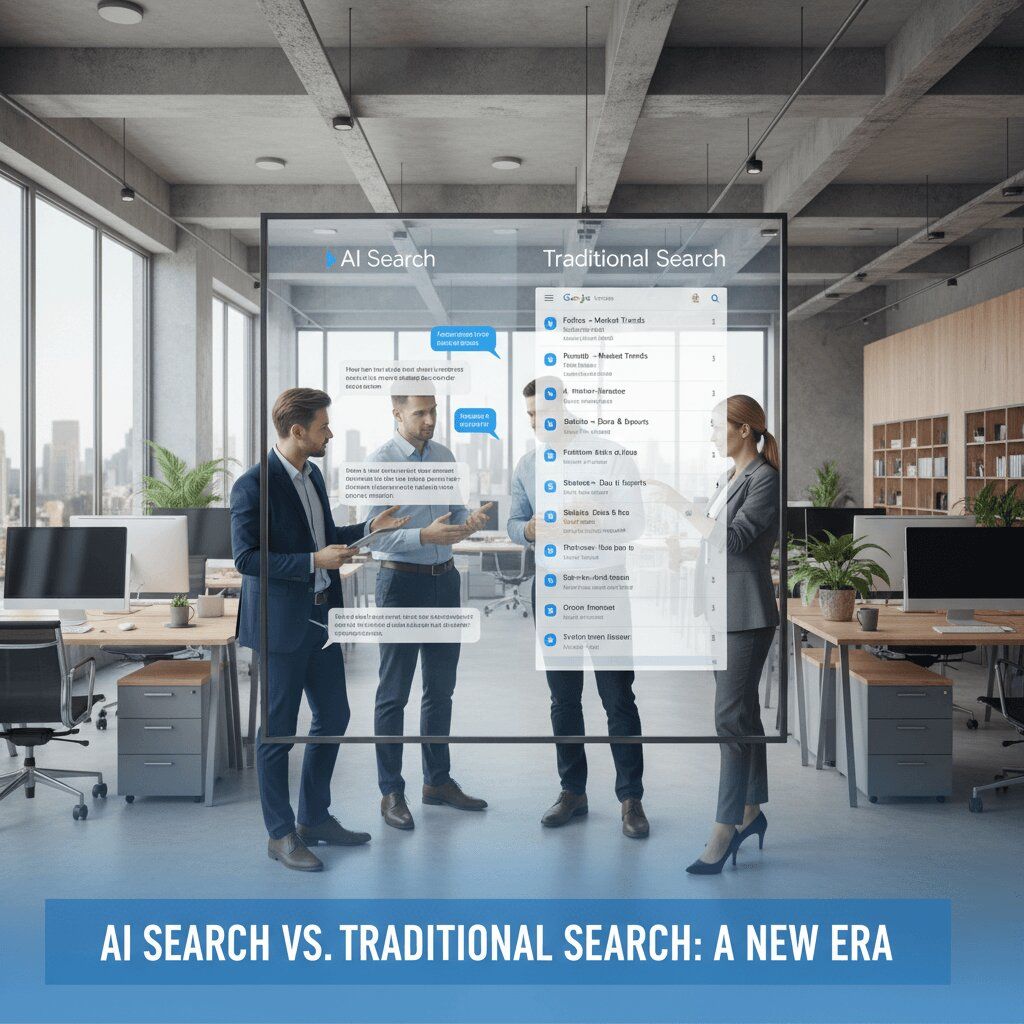
Search is not what it used to be.
For years, traditional search engines showed a list of links and let users decide where to go. Today, AI platforms are changing that experience by delivering direct answers.
This shift is not just technical. It affects how users search, how content is created, and how visibility is achieved.
Understanding the difference between AI search and traditional search is essential for building an effective strategy.
To see how this connects with answer-driven optimization, refer to the Answer Engine Optimization Guide .
How Traditional Search Works
Traditional search engines are built around ranking systems.
They analyze content and display results based on factors like relevance, authority, and keyword alignment.
Users are then expected to:
- Browse multiple results
- Compare information
- Find answers themselves
This model focuses on guiding users toward information rather than delivering it directly.
How AI Search Works
AI search platforms are designed to provide answers, not just options.
They use Natural Language Processing and Machine Learning to:
- Understand queries
- Retrieve relevant information
- Generate structured responses
Instead of showing a list of links, they present a summarized answer based on multiple sources.
This reduces the need for users to explore multiple pages.
Key Differences in User Experience
The difference between traditional and AI search is most visible in how users interact with results.
Traditional search requires effort. Users need to click, read, and compare.
AI search simplifies this process by delivering answers instantly.
This creates:
- Faster access to information
- Reduced navigation
- Higher reliance on AI-generated responses
- User expectations are changing accordingly.
Impact on Content Visibility
Traditional search rewards pages that rank higher.
AI search rewards content that is selected and used in answers.
This changes how visibility is achieved.
Content must now:
- Rank well
- Be easy to interpret
- Be suitable for extraction
Being visible in AI search depends on more than rankings.
Role of Structure and Clarity
AI search prioritizes content that is easy to understand.
Structure plays a major role in this.
Content that is:
- Organized logically
- Clear in explanation
- Focused on answering queries
is more likely to be selected.
Unstructured content is less effective in an AI-driven environment.
To understand how structure supports visibility, refer to Semantic SEO Explained .

From Keywords to Context
Traditional search relied heavily on keywords.
AI search focuses on context and meaning.
AI systems analyze:
- Relationships between concepts
- Intent behind queries
- Depth of information
This shifts content strategy from keyword optimization to context-driven communication.
How AI Search Affects Click Behavior
AI search reduces the need for clicks.
Users can often find what they need without leaving the search interface.
This creates a shift:
- Fewer clicks for simple queries
- Higher importance of visibility within results
- Greater emphasis on content quality
Traffic patterns are changing, but opportunities for influence are increasing.
Role of Authority in Both Models
Authority remains important in both traditional and AI search.
However, the way it is evaluated is evolving.
Traditional search often relies on backlinks and domain strength.
AI search focuses more on:
- Topic coverage
- Content clarity
- Consistency
Authority is now built through structured content systems.
To understand this approach, refer to What is Topical Authority in SEO (/topical-authority).
Common Mistakes When Adapting to AI Search
Many businesses struggle to adapt to this shift.
Common mistakes include:
- Relying only on traditional SEO strategies
- Ignoring content structure
- Focusing only on keywords
- Not covering topics in depth
These issues reduce visibility in AI-driven environments.
To avoid these problems, refer to common SEO mistakes.
How to Adapt Your Strategy
Adapting to AI search requires a balanced approach.
Focus on:
- Maintaining strong SEO fundamentals
- Optimizing content for clarity and structure
- Building topical authority
- Aligning with user intent
This ensures visibility across both traditional and AI search platforms.
To understand how to implement this, refer to How to Optimize Content for AI Answers
The Future of Search
Search will continue to evolve toward answer-based experiences.
AI systems will become more advanced in understanding queries and delivering responses.
Traditional search will still exist, but AI search will play a larger role.
Businesses that adapt early will gain a competitive advantage.
To understand where search is heading, refer to future of SEO.
Conclusion
AI search and traditional search represent two different approaches to delivering information.
Traditional search focuses on guiding users. AI search focuses on providing answers.
Both models will coexist, but the balance is shifting.
Content that is clear, structured, and contextually strong will perform best across both environments.
FAQ
What is the difference between AI search and traditional search
AI search provides direct answers, while traditional search shows ranked links.
Does AI search replace traditional search
No, both will coexist, but AI search is becoming more dominant.
How does AI search impact SEO
It shifts focus from rankings to content selection and clarity.
How should businesses adapt
By combining SEO fundamentals with AEO strategies.
"AI search delivers direct answers, while traditional search lists links—businesses must adapt content to stay visible across both experiences."