

How Long Does SEO Take
SEO is one of the most common growth strategies, but it is also one of the most misunderstood. Many businesses expect immediate results, only to feel frustrated when rankings do not improve quickly.
The reality is simple. SEO takes time because search engines like Google Search need to crawl, index, and evaluate your website before adjusting rankings.
Modern search systems powered by Natural Language Processing (NLP), Machine Learning, and search algorithms also evaluate authority, relevance, and user behavior over time. AI platforms such as ChatGPT and Perplexity AI further prioritize trusted and well-structured content.
SEO is not delayed. It is cumulative. Every action builds momentum.
To understand how SEO works as a complete system, read our comprehensive SEO guide.
Why SEO Takes Time
SEO takes time because search engines follow a structured evaluation process.
Before rankings improve, search engines must:
- Discover your content through crawling
- Store it through indexing
- Evaluate relevance and authority
- Compare it with competing content
This process is not instant. It depends on multiple factors such as competition, content quality, and website authority.
Search engines also rely on behavioral signals and historical data. This means they observe how users interact with your content before adjusting rankings.
To understand how ranking systems operate, read about how search engines determine rankings.
Average SEO Timeline
While timelines vary, most SEO strategies follow a general pattern.
Month 1–2: Research and Setup
- Keyword research and intent analysis
- Technical audit and fixes
- Content planning
Month 3–4: Content and Optimization
- Content creation and optimization
- On-page SEO improvements
- Initial indexing and ranking
Month 5–6: Authority Building
- Backlink acquisition
- Improved rankings for target keywords
- Increased organic traffic
Month 6+: Growth and Scaling
- Consistent traffic growth
- Higher rankings for competitive terms
- Expansion into new topics
SEO timelines depend on execution and consistency.
To understand how to implement this process, refer to SEO process step by step
Factors That Influence SEO Timeline
SEO results are influenced by multiple variables.
- Website Authority
New websites take longer to build trust compared to established domains.
- Competition Level
Highly competitive industries require more time and effort.
- Content Quality
High-quality, intent-driven content performs better and faster.
- Technical SEO
Well-optimized websites get indexed and ranked more efficiently.
- Backlink Profile
Strong authority signals accelerate ranking improvements.
Search engines evaluate all these factors together. Weakness in one area slows down progress.
What Results You Can Expect from SEO
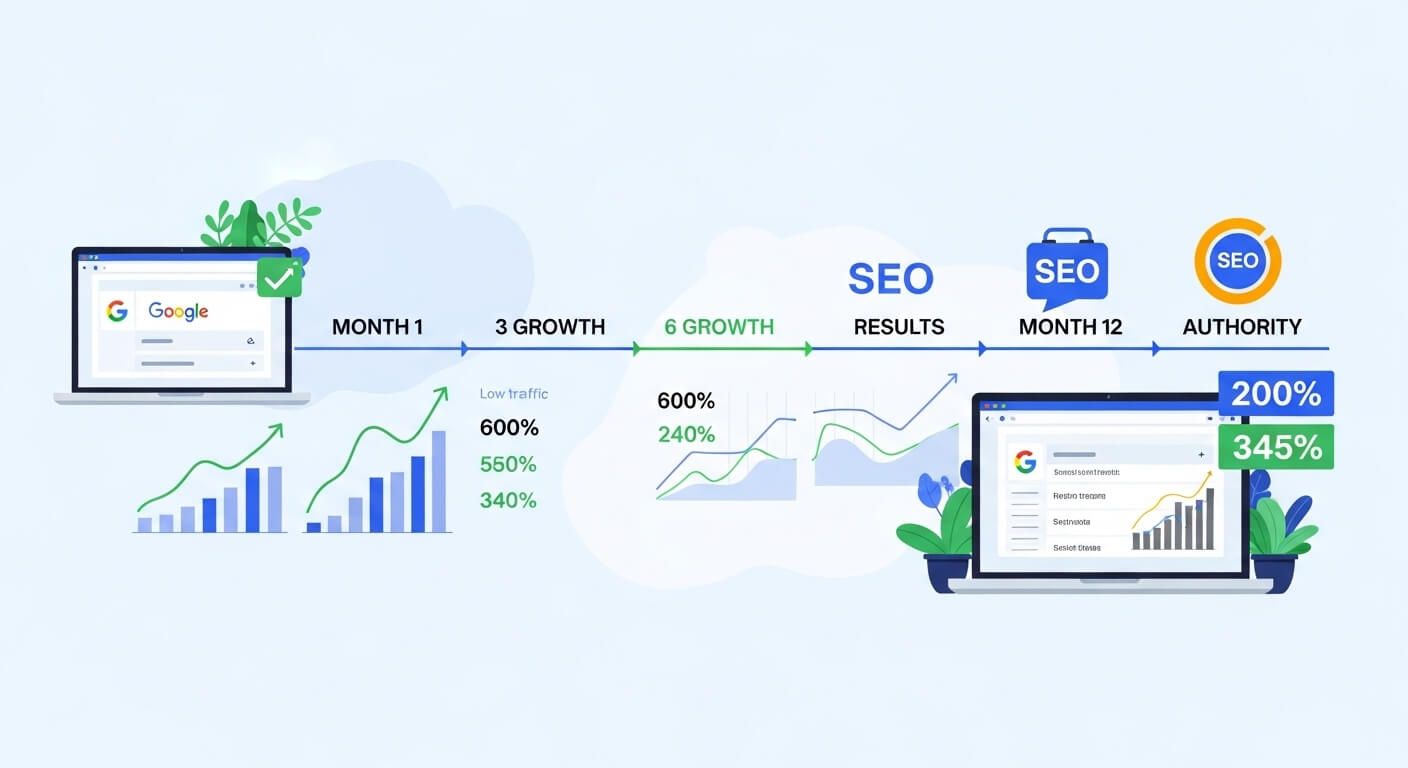
SEO does not deliver results in a single jump. It improves performance in stages.
Early Stage (0–3 Months)
- Pages get crawled and indexed
- Initial keyword visibility begins
- Technical improvements take effect
Mid Stage (3–6 Months)
- Rankings improve for low to medium competition keywords
- Organic traffic starts increasing
- Content begins gaining authority
Growth Stage (6–12 Months)
- Higher rankings for competitive keywords
- Consistent organic traffic growth
- Stronger domain authority
Search engines use Machine Learning to evaluate performance over time. This means consistent improvement signals lead to better rankings.
To measure progress effectively, refer to SEO KPIs to track.
Why Some Websites See Faster Results
Not all websites follow the same timeline. Some achieve results faster due to specific advantages.
Factors that accelerate SEO results include:
- Strong existing domain authority
- High-quality content strategy
- Well-optimized technical structure
- Effective internal linking
- Consistent backlink acquisition
Search engines trust websites that demonstrate relevance and authority early.
AI-driven systems also prioritize structured and well-connected content, which improves visibility across both search engines and answer platforms.
To understand how SEO types contribute to performance, refer to types of SEO explained.
Common Reasons SEO Takes Longer
SEO delays are often caused by avoidable mistakes.
Common reasons include:
- Poor technical SEO setup
- Weak content quality
- Lack of authority signals
- Inconsistent optimization
- Targeting highly competitive keywords too early
Search engines evaluate websites holistically. If one area is weak, overall performance is affected.
To identify these issues, refer to common SEO mistakes.
How to Speed Up SEO Results
While SEO takes time, certain strategies can accelerate results.
Focus on:
- Targeting low-competition, high-intent keywords
- Improving technical performance
- Building strong internal linking
- Creating high-quality, structured content
- Acquiring relevant backlinks
Consistency is the key factor. Search engines reward websites that show continuous improvement.
SEO in the Age of AI Search
AI-driven platforms such as ChatGPT, OpenAI systems, and Perplexity AI are changing how users discover content.
These systems prioritize:
- Structured content
- Clear answers
- Authoritative sources
- Strong entity relationships
This means SEO timelines are influenced not only by Google rankings but also by visibility in AI search.
Websites optimized for semantic search and entity relationships may gain faster exposure across multiple platforms.
To understand how SEO is evolving, refer to future of SEO.
Conclusion
SEO takes time because search engines evaluate content, authority, and user behavior before adjusting rankings.
Results typically begin within a few months, but long-term growth requires consistent effort and optimization.
Businesses that follow a structured process, focus on quality, and build authority see faster and more sustainable results.
"SEO compounds over time. The earlier you start, the faster it grows."